
2.13 Standard Gravities to Meters Per Second Squared
2.13 g ≈ 20.888 m/s²
Calculation: m/s² = 2.13 g × 9.80665 ≈ 20.888 m/s²
Standard Gravity to Meter Per Second Squared Converter
How much acceleration is 2.13 g?
2.13 g (2.13g) is above 1g — comparable to a rocket at liftoff (~1.2g) or a supercar launching 0-100 km/h in under 2.5 seconds.
How to Convert Standard Gravity to Meter Per Second Squared
1 standard gravity = 9.80665 meters per second squared exact
Meter Per Second Squared = Standard Gravity × 9.80665
Example: 2.13 g × 9.80665 = 20.888 m/s²
Reverse Conversion
To convert meters per second squared back to standard gravities:
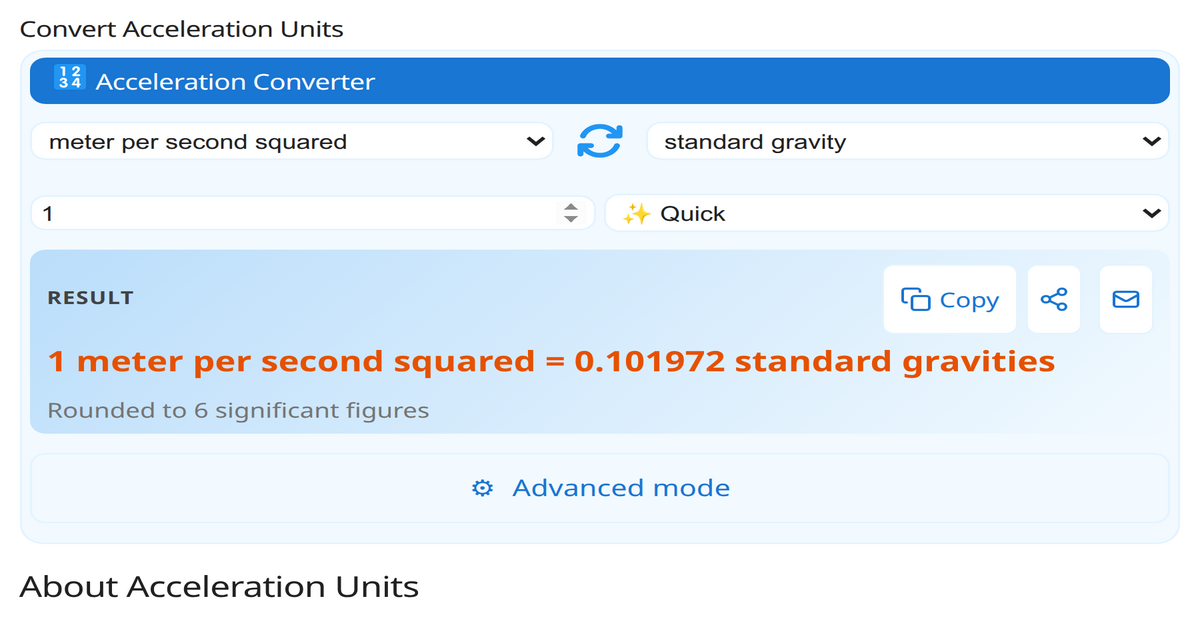
- Remember, 1 meter per second squared equals 0.101972 standard gravities.
- To convert 20.888 m/s² to g, multiply
20.888 x 0.101972, resulting in2.13 g.
exact This conversion factor is exact by international definition.
2.13 g is also equal to:
- 68.531 foot per second squared
- 2088.8 gal
About these units
Standard gravity: Nominal gravitational acceleration at Earth's surface, defined as exactly 9.80665 m/s².
Meter per second squared: SI derived unit of acceleration; change in velocity of 1 meter per second in 1 second.
Frequently Asked Questions
How much is 2.13 standard gravities in meters per second squared?
2.13 standard gravities equals 20.888 meters per second squared. This is calculated by multiplying 2.13 by the conversion factor 9.80665.
What does 2.13 standard gravities look like in meters per second squared?
2.13 standard gravities (20.888 meters per second squared) is moderate g-force — a roller coaster peak or hard braking.
How do you calculate 2.13 standard gravities to meters per second squared?
Multiply 2.13 by the conversion factor 9.80665. The calculation is 2.13 × 9.80665 = 20.888 meters per second squared. This factor is defined by international measurement standards.
Share This Calculation
Nearby Conversions
For general conversions between standard gravities and meters per second squared, see the standard gravities to meters per second squared converter.
Also convert Standard Gravities to:

