
Cups to Grams: The Essential Baking Conversion Chart
Ask three bakers to measure “one cup of flour” and you will get three different amounts of flour. Spooned gently into the cup and leveled, it weighs about 120 grams. Scooped straight from the bag, the same cup packs down to 150 grams or more — a swing of 25% hiding inside a single line of the recipe. That swing is the difference between a tender crumb and a dense one, and it is the reason professional bakers and well-tested recipes generally work in grams.
This guide explains why weight beats volume in baking, gives you the full cups-to-grams chart for 17 baking staples — free to use on your own site — and covers the handful of ingredients where volume measurements go most wrong.
Gram weights on this page are derived from ingredient densities based on USDA FoodData Central and manufacturer data (King Arthur Baking), using the US customary cup of 236.588 mL. The measuring method behind each figure (spooned & leveled, packed, melted) is stated per ingredient class. Last reviewed: July 2026.
The cups-to-grams chart
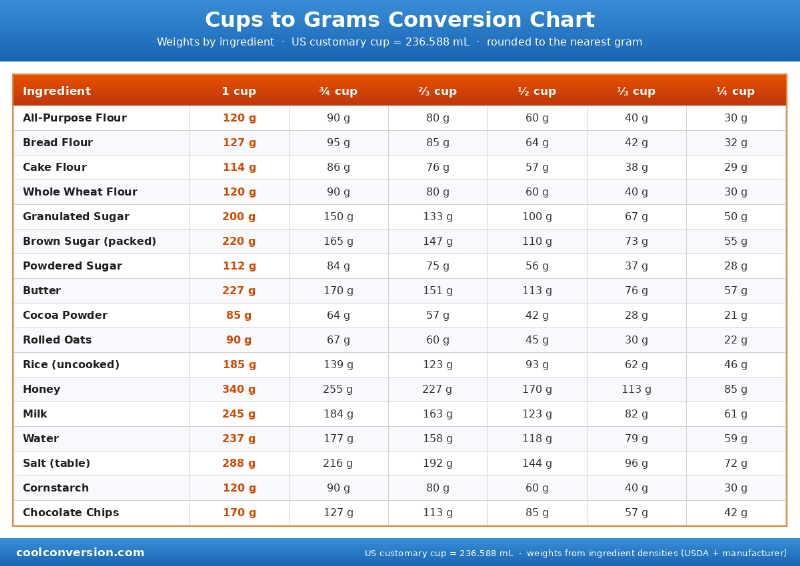
Gram weights for 17 baking staples across every cup fraction. These are the exact figures behind the downloadable image further down — both are generated from a single data file, so they can never disagree.
| Ingredient | 1 cup | ¾ cup | ⅔ cup | ½ cup | ⅓ cup | ¼ cup |
|---|---|---|---|---|---|---|
| All-Purpose Flour | 120 g | 90 g | 80 g | 60 g | 40 g | 30 g |
| Bread Flour | 127 g | 95 g | 85 g | 64 g | 42 g | 32 g |
| Cake Flour | 114 g | 86 g | 76 g | 57 g | 38 g | 29 g |
| Whole Wheat Flour | 120 g | 90 g | 80 g | 60 g | 40 g | 30 g |
| Granulated Sugar | 200 g | 150 g | 133 g | 100 g | 67 g | 50 g |
| Brown Sugar (packed) | 220 g | 165 g | 147 g | 110 g | 73 g | 55 g |
| Powdered Sugar | 112 g | 84 g | 75 g | 56 g | 37 g | 28 g |
| Butter | 227 g | 170 g | 151 g | 113 g | 76 g | 57 g |
| Cocoa Powder | 85 g | 64 g | 57 g | 42 g | 28 g | 21 g |
| Rolled Oats | 90 g | 67 g | 60 g | 45 g | 30 g | 22 g |
| Rice (uncooked) long-grain white |
185 g | 139 g | 123 g | 93 g | 62 g | 46 g |
| Honey | 340 g | 255 g | 227 g | 170 g | 113 g | 85 g |
| Milk whole |
245 g | 184 g | 163 g | 123 g | 82 g | 61 g |
| Water | 237 g | 177 g | 158 g | 118 g | 79 g | 59 g |
| Salt (table) fine table salt |
288 g | 216 g | 192 g | 144 g | 96 g | 72 g |
| Cornstarch | 120 g | 90 g | 80 g | 60 g | 40 g | 30 g |
| Chocolate Chips | 170 g | 127 g | 113 g | 85 g | 57 g | 42 g |
Method: spooned & leveled (All-Purpose Flour, Bread Flour, Cake Flour, Whole Wheat Flour, Cocoa Powder, Cornstarch); packed (Brown Sugar (packed)); unsifted (Powdered Sugar). Brown sugar is packed; liquids (milk, honey, water) by volume. All weights use the US customary cup of 236.588 mL. Ounce equivalents and per-ingredient sources are in the reference table below; for an interactive version see the Cups to Grams Conversion Chart.
Leaveners — baking powder, baking soda, instant yeast — are measured by the teaspoon, not the cup (baking powder is about 4 g per teaspoon), so they are not part of this cup chart.
Why bakers weigh (and cups lie)
A cup is a unit of volume: it tells you how much space an ingredient occupies, not how much of it you actually have. For liquids that distinction barely matters — a cup of water is 237 g today, tomorrow, and in anyone else’s kitchen. For powders and anything compressible, it matters enormously.
Flour is the classic offender. It aerates when sifted, compacts when scooped, and settles in the bag during shipping. The same measuring cup, filled by different hands, delivers meaningfully different amounts of flour — and no amount of care with the recipe’s other steps can compensate for starting with 25% too much of its main ingredient. Brown sugar has the opposite problem: its weight depends on how firmly you press it into the cup, which is why recipes have to specify “packed” at all.
Grams remove the ambiguity. 120 grams of flour is 120 grams however it got into the bowl — sifted, scooped, or shoveled. That is the entire argument: weight is reproducible, volume is technique-dependent. A digital kitchen scale costs about as much as two bags of good chocolate chips and pays for itself the first time a recipe comes out the same way twice.
Until the scale arrives, though, you need reliable equivalents — which is what the chart below is for.
Download & embed the chart
The same 17 weights as a static image — it loads fast, prints cleanly, and pins well. Free to use on your own site: copy the embed code below and keep the credit link.
Use This Table on Your Website
No scale? How to measure by volume correctly
Every gram figure in the chart assumes a specific technique, and for flours and powdered sugar that technique is spoon and level:
- Fluff the flour in its container with a fork or spoon — it settles during storage.
- Spoon it into the measuring cup, letting it mound loosely over the rim. Never dip the cup into the bag and never tap or shake the cup to settle the contents.
- Sweep the excess off with the flat back of a knife, level with the rim.
Done this way, a cup of all-purpose flour lands reliably close to the 120 g in the chart. The dip-and-sweep shortcut — dragging the cup through the bag — compresses the flour against the cup walls and is precisely how a “cup” creeps up to 150 g.
Two deliberate exceptions to spoon-and-level: brown sugar is measured packed (pressed firmly into the cup until it holds its shape when turned out — the chart’s 220 g per cup assumes this), and butter is easiest measured by its wrapper markings, since 1 cup is exactly 2 US sticks.
The ingredients that fool everyone
Brown sugar: “packed” is doing the heavy lifting
Granulated sugar pours densely and consistently — 200 g per cup, hard to get wrong. Brown sugar only reaches its chart weight of 220 g per cup when firmly packed; loosely spooned it can fall dramatically short, and your cookies will spread differently. If a recipe says packed, pack it.
The flours are not interchangeable
All-purpose (120 g), bread flour (127 g), and cake flour (114 g) look identical in the cup but differ by up to 11% by weight — before technique even enters the picture. Cake flour is lighter and finer, bread flour heavier and higher in protein. Substituting by volume compounds two errors at once: the wrong flour and the wrong amount. Whole wheat, for what it’s worth, weighs the same 120 g as all-purpose — the difference there is behavior, not density.
Cocoa powder: the lightest thing in your pantry
At 85 g per cup, cocoa is far lighter than it looks — less than half the weight of the same cup of granulated sugar. It also clumps, which makes volume measurements especially noisy. Recipes that call for a lot of cocoa are the ones where a scale changes the outcome most.
Butter and the stick shortcut
Butter is dense and nearly incompressible — 227 g per cup, which is exactly 2 US sticks (each stick is 113 g / 4 oz; the 1-gram gap versus 2×113 is just rounding). In the US, the wrapper markings are more accurate than any measuring cup, because there is no packing or leveling involved. Half a cup is one stick; done.
Honey and other liquids that are not water
A cup of water weighs 237 g, but a cup of honey weighs 340 g — about 1.4 times as much. Any recipe converting “a cup of sweetener” between honey and sugar by volume alone is quietly changing the sweetness, the moisture, and the browning all at once.
Where these numbers come from
Every weight in the chart is computed from a per-ingredient density (grams per milliliter) applied to the US customary cup of 236.588 mL. The densities come from USDA FoodData Central, cross-checked against manufacturer and baking references — King Arthur Baking for all-purpose flour (120 g) and powdered sugar, Beranbaum’s The Cake Bible for cake flour (114 g), USDA for bread and whole-wheat flour — and each ingredient class carries its stated measuring method: spooned & leveled for flours and powdered sugar, packed for brown sugar, and so on. These are reference values that sit at the upper, spooned-and-leveled end of published ranges (brown sugar packed at 220 g, oats at 90 g); scooped or sifted handling will shift the real weight, which is exactly why weighing beats measuring.
That method declaration matters more than it looks: a gram figure without a stated technique is unfalsifiable. Ours are stated so they can be checked — and they are the same figures, from the same data file, that power the table at the top of this page, the downloadable image, and the interactive chart page. They cannot disagree.
Full reference table — density, measuring method, and source per ingredient:
| Ingredient | 1 cup (g) | 1 cup (oz) | Density (g/mL) | Method | Source |
|---|---|---|---|---|---|
| All-Purpose Flour | 120 g | 4.2 oz | 0.507 | spooned & leveled | King Arthur Baking |
| Bread Flour | 127 g | 4.5 oz | 0.537 | spooned & leveled | USDA FDC |
| Cake Flour | 114 g | 4 oz | 0.482 | spooned & leveled | Beranbaum (The Cake Bible) |
| Whole Wheat Flour | 120 g | 4.2 oz | 0.507 | spooned & leveled | USDA FDC |
| Granulated Sugar | 200 g | 7.1 oz | 0.845 | — | USDA FDC |
| Brown Sugar (packed) | 220 g | 7.8 oz | 0.930 | packed | USDA FDC |
| Powdered Sugar | 112 g | 3.9 oz | 0.473 | unsifted | King Arthur Baking |
| Butter | 227 g | 8 oz | 0.959 | — | US stick standard |
| Cocoa Powder | 85 g | 3 oz | 0.359 | spooned & leveled | King Arthur Baking |
| Rolled Oats | 90 g | 3.2 oz | 0.380 | — | USDA FDC |
| Rice (uncooked) (long-grain white) | 185 g | 6.5 oz | 0.782 | — | USDA FDC |
| Honey | 340 g | 12 oz | 1.437 | — | USDA FDC |
| Milk (whole) | 245 g | 8.6 oz | 1.036 | — | USDA FDC |
| Water | 237 g | 8.3 oz | 1.000 | — | USDA FDC |
| Salt (table) (fine table salt) | 288 g | 10.2 oz | 1.217 | — | USDA FDC |
| Cornstarch | 120 g | 4.2 oz | 0.507 | spooned & leveled | USDA FDC |
| Chocolate Chips | 170 g | 6 oz | 0.719 | — | King Arthur / Nestlé |
Frequently asked questions
How many grams is 1 cup of flour?
120 grams for all-purpose flour, spooned and leveled. Scooped straight from the bag, the same cup can reach 150 g or more.
Is a US cup the same as a metric cup?
No. This chart uses the US customary cup of 236.588 mL. A metric cup is 250 mL — about 5.7% larger — so multiply these gram figures by 1.057 for metric-cup recipes.
Can I use this chart on my website?
Yes — copy the embed code above and keep the credit link. The image stays hosted here and reflects any future data corrections automatically.
Related tools
- Cups to Grams Conversion Chart — the interactive version of the chart above, with every cup fraction
- Cooking Weight to Volume Converter — go the other way: grams and ounces back to cups and tablespoons, for any ingredient
- How many grams in an ounce? — for recipes that mix metric and imperial weights
- How many cups in a quart? — scaling recipes up without leaving volume land
- Butter to Oil Conversion — substituting fats without breaking the recipe