
500 Watts to Kilowatts
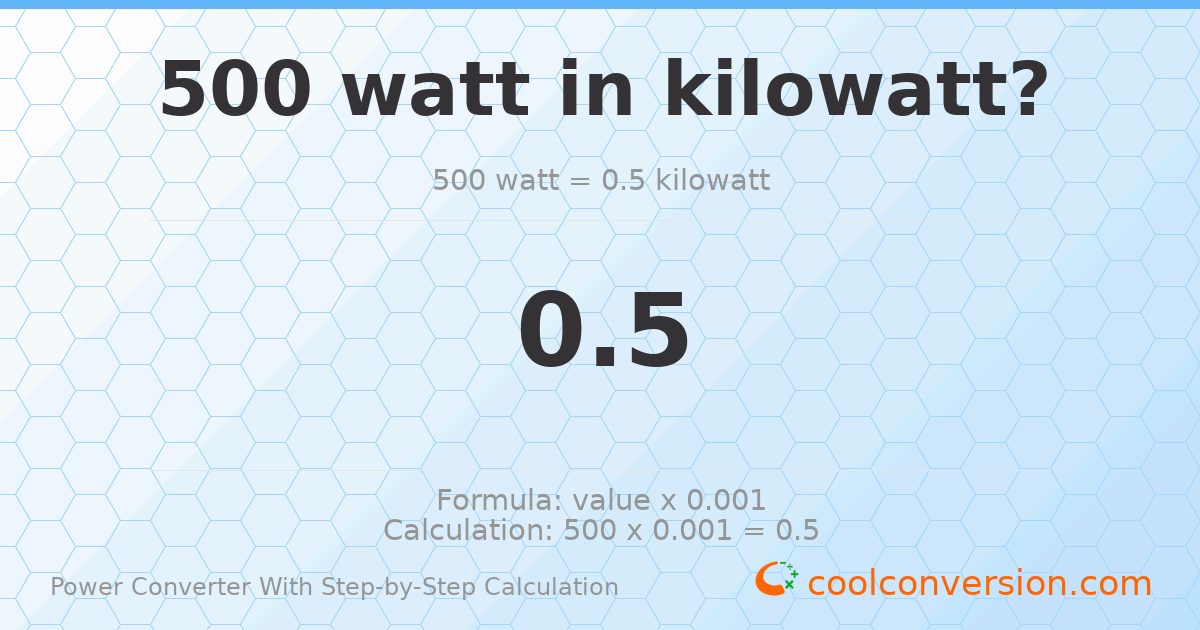
500 W = 0.5 kW
Calculation: kW = 500 W × 0.001 = 0.5 kW
Watt to Kilowatt Converter
How much power is 500 W?
500 W is comparable to a space heater.
What does 500 W look like?

How to Convert Watt to Kilowatt
1 watt = 0.001 kilowatts exact
Kilowatt = Watt × 0.001
Example: 500 W × 0.001 = 12 kW
Reverse Conversion
To convert kilowatts back to watts:
- Remember, 1 kilowatt equals 1000 watts.
- To convert 12 kW to W, multiply
12 x 1000, resulting in500 W.
exact This conversion factor is exact by international definition.
500 W is also equal to:
- 0.0005 megawatt
- 0.67024 horsepower (electric)
About these units
Watt: SI base unit of power equal to one joule per second.
Kilowatt: SI multiple equal to one thousand watts.
Frequently Asked Questions
How much is 500 watts in kilowatts?
500 watts equals 0.5 kilowatts. This is calculated by multiplying 500 by the conversion factor 0.001.
What does 500 watts look like in kilowatts?
500 watts (0.5 kilowatts) is a large appliance — a microwave, a hair dryer, or a space heater (US max 1,500 W on a 15 A circuit).
How do you calculate 500 watts to kilowatts?
Multiply 500 by the conversion factor 0.001. The calculation is 500 × 0.001 = 0.5 kilowatts. This factor is defined by international measurement standards.
Share This Calculation
For general conversions between watts and kilowatts, see the watts to kilowatts converter.
Also convert Watts to:

