
100 Grams to Ounces
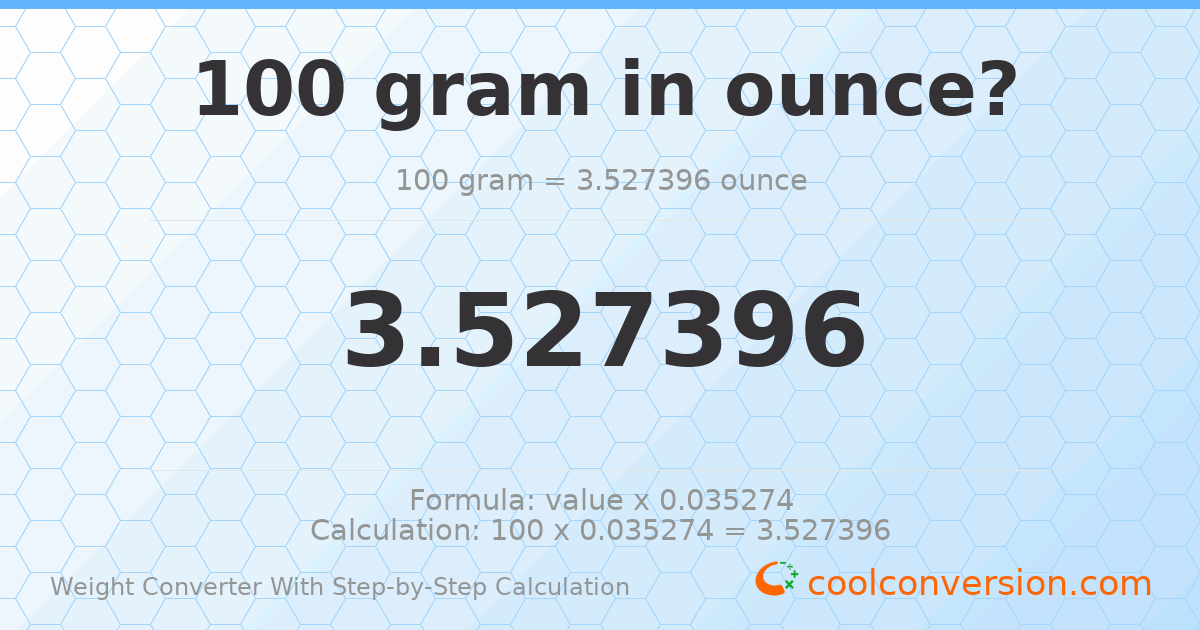
100 g ≈ 3.5274 oz
Calculation: oz = 100 g × 0.035274 ≈ 3.5274 oz
Gram to Ounce Converter
How heavy is 100 g?
100 g (0.1 kg) is comparable to the weight of a smartphone or a small book.
100 g on the ounce scale
100.0 g = 3.527 oz
How to Convert Gram to Ounce
1 gram = 0.035274 ounces exact
Ounce = Gram × 0.035274
Example: 100 g × 0.035274 = 3.5274 oz
Reverse Conversion
To convert ounces back to grams:
- Remember, 1 ounce equals 28.3495 grams.
- To convert 3.5274 oz to g, multiply
3.5274 x 28.3495, resulting in100 g.
exact This conversion factor is exact by international definition.
100 g is also equal to:
- 100000 milligram
- 0.1 kilogram
- 0.22046 pound
- 0.015747 stone
About these units
Gram: The gram (g) is a metric unit of mass equal to one thousandth of a kilogram. It is widely used for measuring small quantities, particularly in food labeling, chemistry, and laboratory work.Although no...
Ounce: The ounce (oz) is a unit of mass equal to one sixteenth of a pound in the avoirdupois system.
Frequently Asked Questions
How much is 100 grams in ounces?
100 grams equals 3.5274 ounces. This is calculated by multiplying 100 by the conversion factor 0.035274.
What does 100 grams look like in ounces?
100 grams (3.5274 ounces) is comparable to a smartphone, a cup of sugar, or an orange.
How do you calculate 100 grams to ounces?
Multiply 100 by the conversion factor 0.035274. The calculation is 100 × 0.035274 = 3.5274 ounces. This factor is defined by international measurement standards.
Share This Calculation
For general conversions between grams and ounces, see the grams to ounces converter.
Also convert Grams to:

