
GCF of 1, 4 and 9 = 1 (Coprime)
Quick Answer
GCF(1, 4 and 9) = 1. 1, 4 and 9 are coprime (share only the divisor 1).
Common divisors: 1.
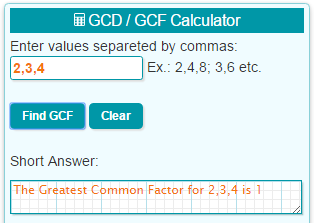
GCF Calculator
Step-by-Step: Euclidean Algorithm
The Euclidean algorithm finds the GCF by repeated division: divide the larger by the smaller, replace with the remainder, repeat until the remainder is 0. The last non-zero divisor is the GCF.
For 3 numbers, apply Euclidean pairwise: GCF(1, 4, 9) = GCF(GCF(1, 4), 9).
The table below shows the first reduction (between 1 and 4):
| Step | Dividend ÷ Divisor | Quotient | Remainder |
|---|---|---|---|
| 1 | 4 ÷ 1 | 4 | 0 |
GCF(1, 4 and 9) = 1
Common Divisors of 1, 4 and 9
Since 1, 4 and 9 are coprime, the only common divisor is 1.
1, 4 and 9 Are Coprime
Two (or more) integers are coprime (also called relatively prime) when their GCF equals 1 — they share no common divisors other than 1. 1, 4 and 9 qualify.
Note: coprime numbers do not need to be prime individually. For example, 8 and 15 are coprime (GCF = 1), but neither is prime — 8 = 2³ and 15 = 3 × 5 share no prime factors.
Explore Each Number Individually
How to Find the Greatest Common Factor
The Greatest Common Factor (GCF) of two or more numbers is the largest positive integer that divides each of the numbers without leaving a remainder.
Method 1: Euclidean Algorithm (used above)
- Divide the larger number by the smaller. Note the remainder.
- Replace the pair (larger, smaller) with (smaller, remainder).
- Repeat until the remainder is 0. The last non-zero divisor is the GCF.
Method 2: Listing Factors
- List all factors of each number
- Identify the factors that appear in all lists (common factors)
- Select the largest common factor — this is the GCF
Method 3: Prime Factorization
- Find the prime factorization of each number
- Identify which prime factors appear in all factorizations
- For each common prime factor, take the lowest exponent
- Multiply these prime factors raised to their lowest exponents
GCF = product of (common prime factors)lowest exponent
Example: GCF(12, 18) using prime factorization
- 12 = 2² × 3¹
- 18 = 2¹ × 3²
- Common primes: 2 and 3 — take the lowest exponent of each
- GCF = 2¹ × 3¹ = 6
Frequently Asked Questions
What is the GCF of 1, 4 and 9?
GCF(1, 4 and 9) = 1. This is the largest integer that divides each of the inputs without remainder.
How do you find the GCF of 1, 4 and 9?
Apply the Euclidean algorithm (see the step-by-step table above). For 3 numbers, reduce pairwise: GCF(a, b, c) = GCF(GCF(a, b), c).
Are 1, 4 and 9 coprime?
Yes. 1, 4 and 9 are coprime (relatively prime) because their GCF is 1 — they share no common divisor other than 1.
What are coprime numbers?
Two or more numbers are coprime (or relatively prime) if their GCF is 1. Example: GCF(8, 15) = 1.
What are other names for GCF?
The GCF is also known as GCD (Greatest Common Divisor, math) and HCF (Highest Common Factor, British education). All three terms are equivalent.
Related Calculators
GCF Calculator
Popular GCF Calculations
Top greatest common factor calculations: