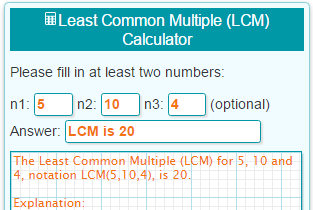
LCM of 4, 5 and 12 = 60
Quick Answer
LCM(4, 5 and 12) = 60.
First common multiples: 60, 120, 180, 240, 300.
LCM Calculator
Step-by-Step: LCM via the GCF Identity
The fastest way to compute the LCM uses the identity LCM(a, b) × GCF(a, b) = a × b. So LCM = (a × b) / GCF. We first find the GCF with the Euclidean algorithm, then apply the identity.
For 3 numbers, reduce pairwise: LCM(4, 5, 12) = LCM(LCM(4, 5), 12) = 60. The Euclidean steps below show the first reduction (between 4 and 5):
| Step | Dividend ÷ Divisor | Quotient | Remainder |
|---|---|---|---|
| 1 | 5 ÷ 4 | 1 | 1 |
| 2 | 4 ÷ 1 | 4 | 0 |
GCF = 1.
LCM(4, 5 and 12) = 60
First 5 Common Multiples of 4, 5 and 12
Every common multiple is a multiple of the LCM. The first five are:
| k | k × LCM | Value |
|---|---|---|
| 1 | 1 × 60 | 60 |
| 2 | 2 × 60 | 120 |
| 3 | 3 × 60 | 180 |
| 4 | 4 × 60 | 240 |
| 5 | 5 × 60 | 300 |
Explore Each Number Individually
How to Find the Least Common Multiple
The Least Common Multiple (LCM) of two or more positive integers is the smallest positive integer divisible by each of them.
Method 1: GCF Identity (used above)
- Find the GCF (Greatest Common Factor) using the Euclidean algorithm.
- Apply the identity: LCM = (a × b) / GCF.
Method 2: Prime Factorization
- Find the prime factorization of each number.
- For each prime that appears in any factorization, take the highest exponent across all inputs.
- Multiply these prime powers together.
Example: LCM(12, 18) via prime factorization
- 12 = 2² × 3¹
- 18 = 2¹ × 3²
- Take the highest exponent of each prime: 2² (from 12), 3² (from 18).
- LCM = 2² × 3² = 4 × 9 = 36
Method 3: Listing Multiples
- List the multiples of each number until you find a common one.
- That smallest common multiple is the LCM.
This is the slowest method for large inputs; the GCF identity is preferred.
Nearby LCM Examples
Frequently Asked Questions
What is the LCM of 4, 5 and 12?
LCM(4, 5 and 12) = 60. This is the smallest positive integer divisible by each input.
How is the LCM of 4, 5 and 12 calculated?
Apply the identity LCM = (a × b) / GCF. For 4, 5 and 12, GCF = 1, so LCM = 240 / 1 = 60.
Why does LCM(4, 5 and 12) equal their product?
Because 4, 5 and 12 are coprime (GCF = 1). Whenever two numbers share no common factor greater than 1, their least common multiple is just their product.
How are LCM and GCF related?
By the identity LCM(a, b) × GCF(a, b) = a × b. So once you have the GCF (via the Euclidean algorithm), the LCM follows immediately: LCM = (a × b) / GCF.
What is LCM used for?
Two major uses: (1) adding/subtracting fractions with different denominators (find the common denominator); (2) scheduling — when two repeating events occur together (every 12 days and every 18 days → coincide every LCM(12, 18) = 36 days).
Related Calculators
- Greatest Common Factor (GCF) Calculator
- Prime Factorization Calculator
- Divisors of a Number
- Multiples of a Number
- Fraction Calculator (uses LCM for common denominators)
LCM Calculator