
150 Psi to MPa
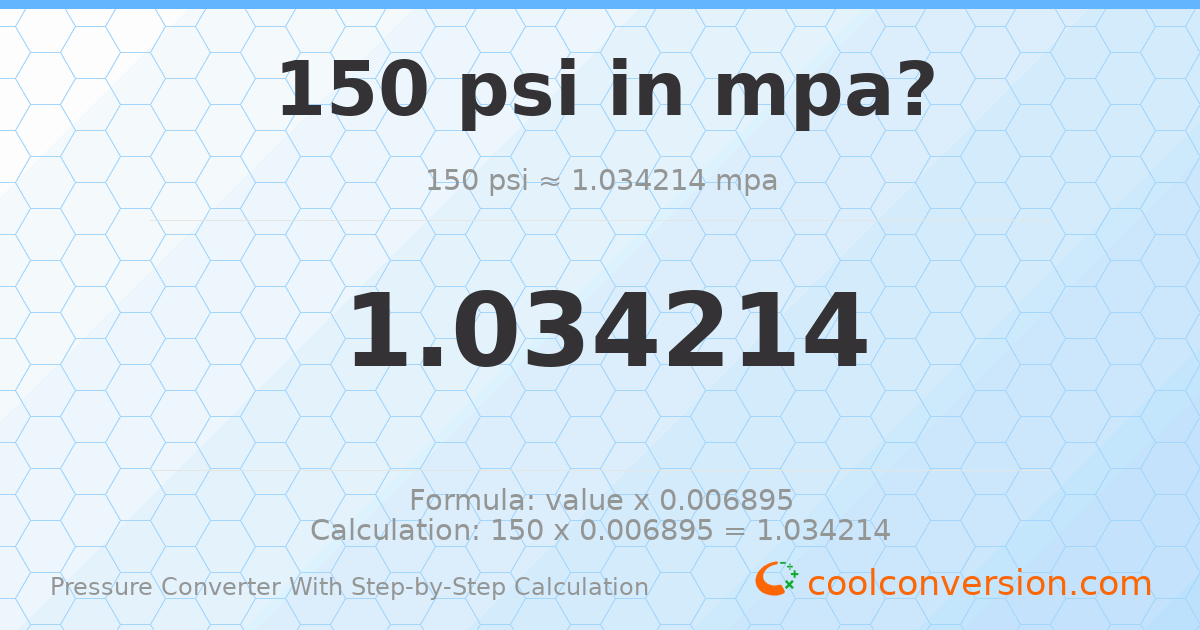
150 psi ≈ 1.0342 MPa
Calculation: MPa = 150 psi × 0.00689476 ≈ 1.0342 MPa
Psi to MPa Converter
How much pressure is 150 psi?
150 psi (1,034 kPa) is comparable to the internal pressure of a fire extinguisher.
What does 150 psi look like?

Did you know? Fire extinguisher is 1,200 kPa.
A stored-pressure fire extinguisher operates at about 1,200 kPa (175 psi).
How to Convert Psi to MPa
1 psi = 0.00689476 MPa
MPa = Psi × 0.00689476
Example: 150 psi × 0.00689476 = 1.0342 MPa
Reverse Conversion
To convert MPa back to psi:
- Remember, 1 MPa equals 145.038 psi.
- To convert 1.0342 MPa to psi, multiply
1.0342 x 145.038, resulting in150 psi.
150 psi is also equal to:
- 1034200 pascal
- 1034.2 kPa
- 10.342 bar
About these units
Psi: Imperial/US customary pressure unit equal to one pound-force per square inch.
MPa: SI-derived pressure unit equal to 1,000,000 pascals (10⁶ Pa).
Frequently Asked Questions
How much is 150 psi in MPa?
150 psi equals 1.0342 MPa. This is calculated by multiplying 150 by the conversion factor 0.00689476.
What does 150 psi look like in MPa?
150 psi (1.0342 MPa) is in the range of high-pressure systems — typical of road bicycle tires, hydraulic tools, and compressed gas regulators.
How do you calculate 150 psi to MPa?
Multiply 150 by the conversion factor 0.00689476. The calculation is 150 × 0.00689476 = 1.0342 MPa. This factor is defined by international measurement standards.
Share This Calculation
Nearby Conversions
For general conversions between psi and MPa, see the psi to MPa converter.
Also convert Psi to:

