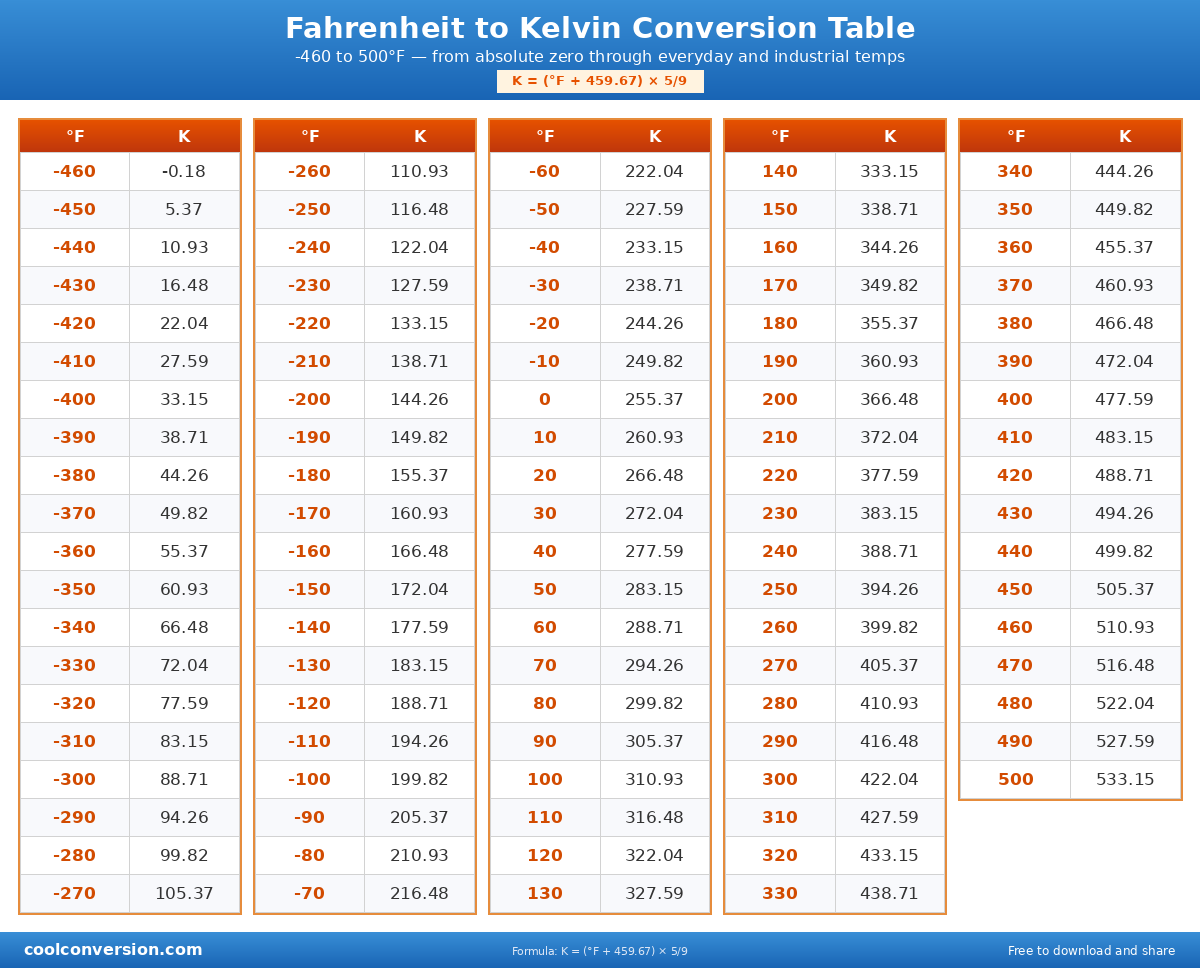
Fahrenheit to Kelvin Conversion Table
-460 to 500°F — from absolute zero through everyday and industrial temps
Any temperature value in °F can be converted to K using the conversion factor:
- 1 Fahrenheit = 255.928 Kelvin
- K = (°F + 459.67) × 5/9
°F → K Quick Converter
Need more features? Try our complete Fahrenheit to Kelvin converter.
Conversion Chart Image
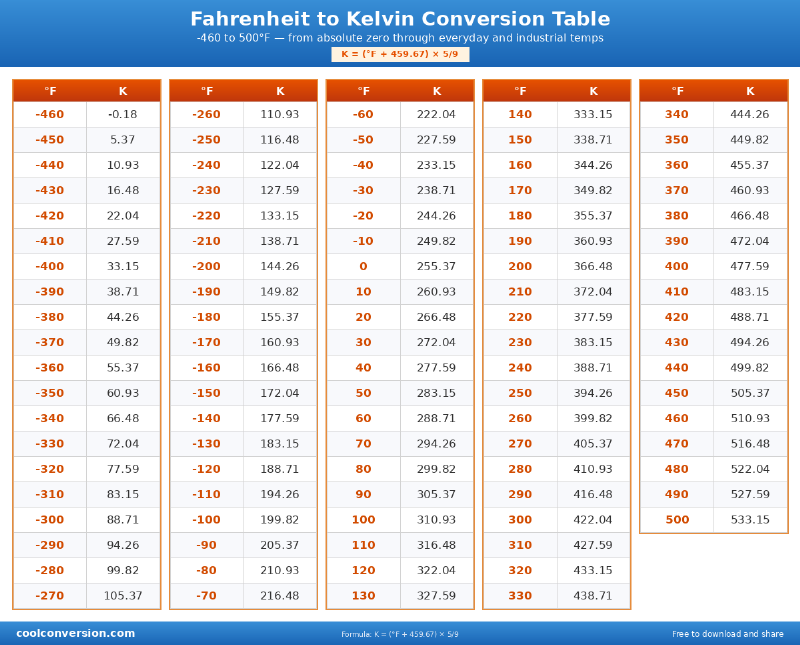
Use This Table on Your Website
Download Options
What is Fahrenheit (°F)?
The degree Fahrenheit (°F) is a temperature unit in the US customary system. On this scale, the freezing point of water is 32 °F and the boiling point is 212 °F — exactly 180 degrees apart.
What is Kelvin (K)?
The kelvin (K) is the SI base unit of thermodynamic temperature. Since the 2019 SI redefinition, it is defined by fixing the Boltzmann constant at exactly 1.380 649 × 10⁻²³ J/K.
How to Convert Fahrenheit to Kelvin
Example
Convert -370 °F to K:
-370 °F = 49.8167 K
Fahrenheit to Kelvin Conversion Table
Values from -460 to 500 °F.
Frequently Asked Questions
What is absolute zero in Fahrenheit?
Absolute zero is -459.67°F, which equals 0 K. This is the lowest possible temperature, where all thermal motion of particles ceases.
What is 32°F in Kelvin?
32°F (the freezing point of water) equals 273.15 K. Using the formula: (32 + 459.67) × 5/9 = 273.15 K.
How do I convert Fahrenheit to Kelvin?
Add 459.67 to the Fahrenheit value, then multiply by 5/9. For example, 212°F: (212 + 459.67) × 5/9 = 373.15 K (the boiling point of water).
What is room temperature (72°F) in Kelvin?
72°F equals approximately 295.37 K. Using the formula: (72 + 459.67) × 5/9 = 295.37 K. This is close to the standard 298.15 K (25°C) often used in science.
Why would I need to convert Fahrenheit to Kelvin?
This conversion is useful when applying scientific formulas that require absolute temperature (Kelvin) to data originally measured in Fahrenheit, common in US-based engineering, HVAC, and laboratory settings.