
2140 Seconds to Microseconds
2140 s = 2140000000 µs
Calculation: µs = 2140 s × 1000000 = 2140000000 µs
Second to Microsecond Converter
How long is 2,140 s?
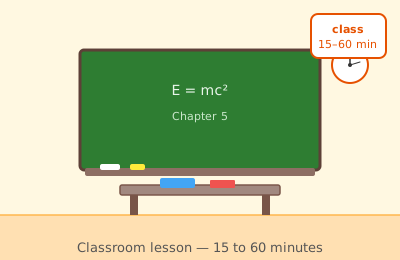
2,140 seconds is comparable to the duration of a school class or meeting.
What does 2,140 s look like?
How to Convert Second to Microsecond
1 second = 1000000 microseconds
Microsecond = Second × 1000000
Example: 2140 s × 1000000 = 2.14 × 10⁹ µs
Reverse Conversion
To convert microseconds back to seconds:
- Remember, 1 microsecond equals 1 × 10⁻⁶ seconds.
- To convert 2.14 × 10⁹ µs to s, multiply
2.14 × 109 x 1 × 10-6, resulting in2140 s.
2140 s is also equal to:
- 35.667 minute
- 0.59444 hour
- 0.024769 day
- 0.0035384 week
- 0.00081375 month (mean)
Frequently Asked Questions
How much is 2140 seconds in microseconds?
2140 seconds equals 2.14 × 10⁹ microseconds. This is calculated by multiplying 2140 by the conversion factor 1000000.
What does 2140 seconds look like in microseconds?
2140 seconds (2.14 × 10⁹ microseconds) is five minutes to an hour — a class period or a meeting.
How do you calculate 2140 seconds to microseconds?
Multiply 2140 by the conversion factor 1000000. The calculation is 2140 × 1000000 = 2.14 × 10⁹ microseconds. This factor is defined by international measurement standards.
Share This Calculation
Nearby Conversions
For general conversions between seconds and microseconds, see the seconds to microseconds converter.
Also convert Seconds to:
Related Time Tools
- Hours to Decimal Converter — for payroll and timesheets
- Military Time Converter — 24-hour ↔ 12-hour clock
- Days From Today — date math from today
- Days Until — countdown to any holiday or date
- Time References — seconds, minutes, hours, weeks per day/year

