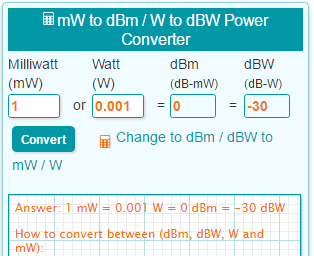
Convert 50 mW to dBm
About This Calculator
Convert electric power units from milliwatts (mW) or watts (W) to decibel-milliwatts (dBm) or decibel-watts (dBW). Essential for RF engineering, telecommunications, and wireless communications.
Where is dBm Used?
The decibel-milliwatt (dBm) is the standard power measurement unit in:
- Wi-Fi Signal Strength - Routers and access points report signal power in dBm. Typical values: -30 dBm (excellent) to -90 dBm (weak).
- Cellular Networks - 4G/5G signal strength is measured in dBm. -50 dBm is strong, -100 dBm is poor.
- RF Engineering - Radio transmitters, receivers, and amplifiers use dBm for power calculations.
- Fiber Optics - Optical power levels in fiber networks are expressed in dBm.
- Bluetooth - Transmit power classes are defined in dBm (Class 1: 20 dBm, Class 2: 4 dBm).
Why use dBm? The logarithmic scale makes it easier to calculate gains and losses in signal chains - simply add or subtract dB values instead of multiplying power ratios.
mW to dBm Formula
dBm Definition: dBm is the power ratio in decibels (dB) of the measured power referenced to one milliwatt (mW).
The formula can be expressed as: "the power P(dBm) in dBm is equal to 10 times the base 10 logarithm of the power P(mW) in milliwatts divided by 1 milliwatt":
P(dBm) = 10 × log₁₀(P(mW) / 1 mW)
Therefore, P = 1 mW is equal to 0 dBm
Example:
Convert 100 mW to dBm:
P(dBm) = 10 × log₁₀(100 mW / 1 mW) = 20 dBm
W to dBW Formula
The decibel-watt (dBW) is the power ratio in decibels (dB) of the measured power referenced to one Watt (W):
P(dBW) = 10 × log₁₀(P(W) / 1 W)
Example:
Convert 10 W to dBW:
P(dBW) = 10 × log₁₀(10 W / 1 W) = 10 dBW
Relationship Between dBm and dBW
Since 1 W = 1000 mW:
- dBW = dBm − 30
- dBm = dBW + 30
Quick Reference Table
Common mW to dBm conversions. See complete table →
Milliwatts to dBm Conversion Table
0.001 mW to 10,000 mW
Frequently Asked Questions
What is dBm?
dBm (decibel-milliwatt) is a logarithmic unit of power referenced to 1 milliwatt. It's commonly used in RF engineering, telecommunications, and wireless networking. The formula is: P(dBm) = 10 × log₁₀(P(mW)/1mW). So 0 dBm = 1 mW.
Why use dBm instead of mW?
dBm uses a logarithmic scale, making it easier to work with the huge range of power levels in RF systems (from nanowatts to megawatts). Calculations become simpler: gains and losses can be added/subtracted instead of multiplied/divided.
How do I convert dBm to dBW?
To convert dBm to dBW, subtract 30: dBW = dBm − 30. For example, 30 dBm = 0 dBW (which equals 1 Watt). To convert back: dBm = dBW + 30.
What is 0 dBm in milliwatts?
0 dBm equals exactly 1 milliwatt (1 mW). This is the reference point for the dBm scale. Every 10 dB increase represents a 10× power increase, so 10 dBm = 10 mW, 20 dBm = 100 mW, 30 dBm = 1000 mW = 1 W.
What is a good Wi-Fi signal strength in dBm?
For Wi-Fi signal strength: -30 to -50 dBm is excellent, -50 to -60 dBm is good, -60 to -70 dBm is fair, and below -70 dBm is weak. Most devices need at least -70 dBm for reliable connectivity.
How many mW is 20 dBm?
20 dBm = 100 mW. Using the formula: P(mW) = 10^(dBm/10) = 10^(20/10) = 10² = 100 mW. This is a common transmit power for Wi-Fi routers.
What is 1 Watt in dBm?
1 Watt = 30 dBm. Since 1 W = 1000 mW, we calculate: dBm = 10 × log₁₀(1000) = 10 × 3 = 30 dBm. This is also 0 dBW (decibel-watts).
Share this Calculator