
Calculate 2 log of 320 | Log2 Calculator
Here is the answer to questions like: Calculate 2 log of 320 or what is the base 2 log of 320?
Use our | Log2 calculator to find the logarithm of any positive number for any number base you enter.
Frequently Asked Questions About Log2(320)
What Is The Base 2 Logarithm Of 320?
The base 2 logarithm of 320 is approximately 8.321928.
In mathematical notation: log2(320) = 8.321928
How Do You Calculate Log2(320)?
To calculate log2(320), use the change of base formula:
log2(320) = ln(320) / ln(2)
Where ln is the natural logarithm. This gives us:
5.768321 / 0.693147 ≈ 8.321928
What Does Log2(320) = 8.3219 Mean?
This means that 2 raised to the power of 8.3219 equals 320:
28.3219 = 320
In other words, if you multiply 2 by itself 8.3219 times, you get 320.
What Is Special About Base 2 Logarithms?
Base 2 logarithms are commonly used in computer science and information theory because computers work in binary (base 2).
They tell us how many times we need to divide a number by 2 to reach 1, which is useful for analyzing algorithms and data structures.
For example: log2(320) = 8.321928 means 320 = 28.321928
Can I Calculate Other Values Using This Base?
Yes! Our calculator works with any base and any positive number. Try these related calculations:
What is logarithm?
A logarithm is the power to which a number must be raised in order to get some other number. In other words, the logarithm tells us how many of one number should be multiplied to get another number.
For example:
- The base 2 logarithm of 4 is 2, because 2 raised to the power of 2 is 4:
- log3 9 = 2, because 32 = 9
This is an example of a base-3 logarithm. We call it a base-3 logarithm because 3 is the number that is raised to a power.
The most common logarithms are natural logarithms and base 10 logarithms. There are special notations for them:
- A base 10 log is written simply log.
- A natural logarithm is written simply as ln.
So, the notation log alone means base ten logarithm and notation ln, means natural log.
Basic Log Rules
- logb(x·y) = logb(x) + logb(y)
- logb(x/y) = logb(x) - logb(y)
- logb(xy) = y·logb(x)
- logb(x) = logk(x)/logk(b)
Common Logarithm Values - Quick Reference Table
Here are the most frequently searched logarithm calculations. Click any value for detailed step-by-step solution:
Base 10 Logarithms (Common Logarithms)
| Expression | Result | Explanation |
|---|---|---|
| log10(1) | 0 | 100 = 1 |
| log10(10) | 1 | 101 = 10 |
| log10(100) | 2 | 102 = 100 |
| log10(1000) | 3 | 103 = 1000 |
| log10(10000) | 4 | 104 = 10000 |
Base 2 Logarithms (Binary Logarithms)
| Expression | Result | Explanation |
|---|---|---|
| log2(1) | 0 | 20 = 1 |
| log2(2) | 1 | 21 = 2 |
| log2(4) | 2 | 22 = 4 |
| log2(8) | 3 | 23 = 8 |
| log2(16) | 4 | 24 = 16 |
| log2(32) | 5 | 25 = 32 |
Natural Logarithms (Base e)
| Expression | Result | Explanation |
|---|---|---|
| ln(1) | 0 | e0 = 1 |
| ln(e) | 1 | e1 = e ≈ 2.71828 |
| ln(2) | 0.693147 | e0.693147 ≈ 2 |
| ln(10) | 2.302585 | e2.302585 ≈ 10 |
Why these values matter: These common logarithm values appear frequently in science, engineering, computer science, and mathematics. Memorizing them can help with quick mental calculations and problem-solving.
What is logarithm and how it works
If you want to learn the basic concept of logarithms and its basic operation, you should try to watch this simple video: Logarithms Explained and Rules of Logarithms
Related Math Calculators
Expand your mathematical toolkit with these related calculators that complement logarithm calculations:
Exponent Calculator
Calculate powers and exponential expressions. The inverse operation of logarithms - perfect for verifying your log calculations.
Example: 23 = 8, which verifies that log2(8) = 3
Calculate Exponents →Scientific Notation Converter
Convert between scientific notation and decimal form. Useful when working with very large or small numbers in logarithmic calculations.
Example: Convert 1.2e3 to 1200 for log calculations
Convert Notation →Square Root Calculator
Calculate square roots with detailed solutions. Related to logarithms through fractional exponents (√x = x1/2).
Example: √16 = 4, which relates to log16(4) = 0.5
Calculate Square Roots →Percentage Calculator
Calculate percentages, percentage change, and more. Useful for growth rate calculations that often involve logarithms.
Use case: Compound interest and exponential growth/decay problems
Calculate Percentages →Fraction to Decimal Converter
Convert fractions to decimals for easier logarithm calculations. Our calculator accepts decimal inputs.
Example: Convert 3/4 to 0.75 before calculating log10(0.75)
Convert Fractions →GCF Calculator
Find the greatest common factor. Helpful when simplifying logarithmic expressions with integer values.
Use case: Simplifying log properties and relationships
Find GCF →Pro tip: Logarithms are used extensively in science, engineering, finance, and computer science. Understanding related mathematical operations helps solve complex real-world problems involving exponential growth, pH calculations, decibel levels, and algorithm complexity analysis.
Log Calculator
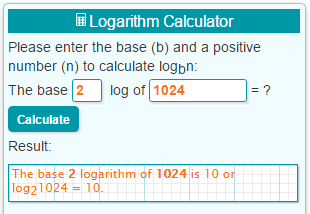
Please link to this page! Just right click on the above image, choose 'copy link address', then past it in your HTML.
Sample Logarithm Calculations
Calculate logarithms of these values: